10 Proven Ways to Stamp Out Training-Serving Skew
Introduction
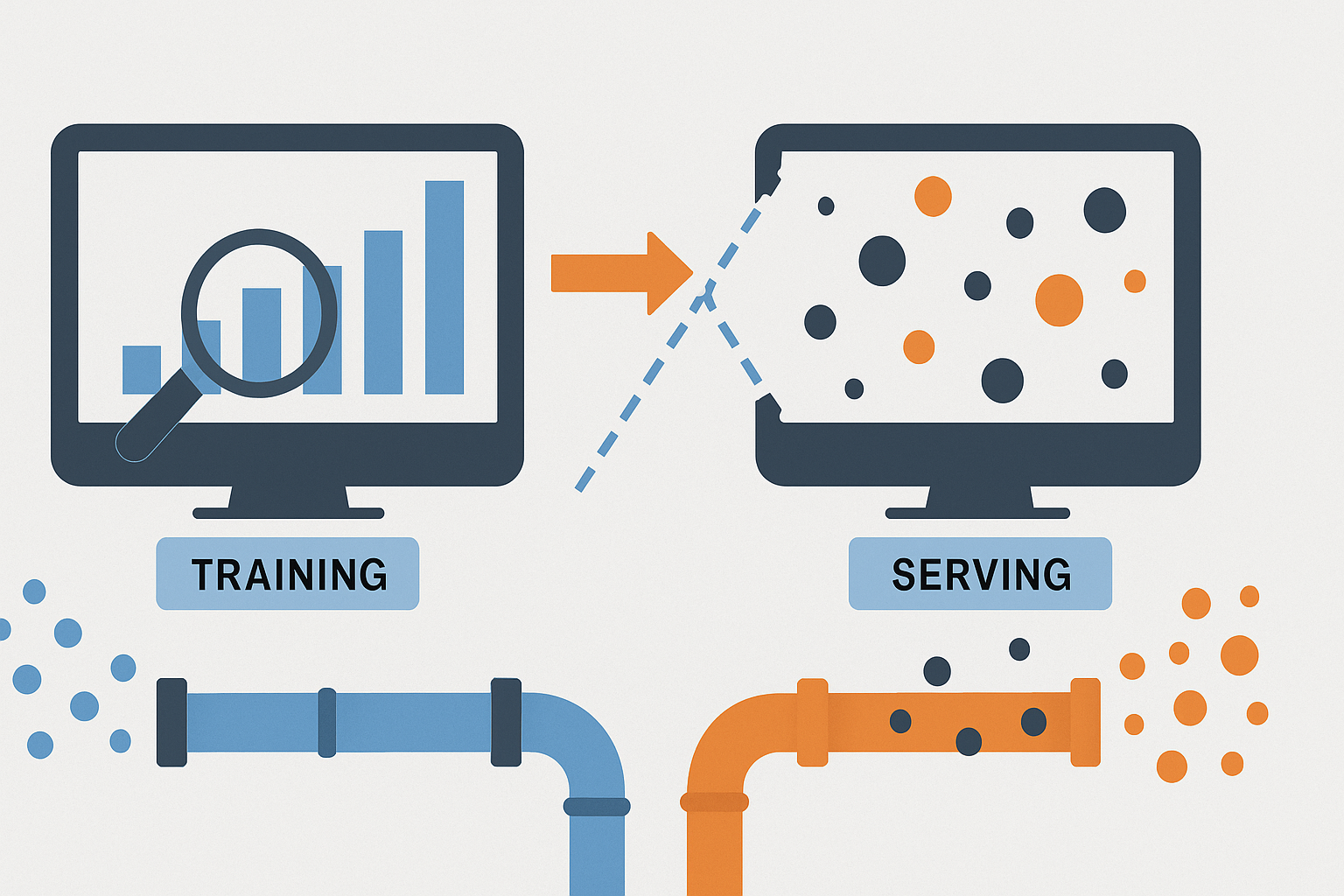
You spend months perfecting your machine learning model. The accuracy climbs, the cross-validation curves look beautiful, and your team greenlights production. But then something breaks. Users complain, metrics dip, and your once-perfect model suddenly underperforms in the real world🥲.
You’ve just been hit by one of the most common, and most expensive, killers of ML ROI: training-serving skew.
That’s exactly what happened to Google Health.
Their diabetic-retinopathy model dazzled in the lab, spotting disease with >90 % accuracy. But in the first clinic trial, harsh ward lighting muddied the images and the model’s precision plummeted; forcing nurses back to manual checks and delaying sight-saving treatments [3].
The Stakes
Training-serving skew quietly drains ROI. In 2019 alone, companies poured £22 bn ($28.5 bn) into ML, yet only 35 % of models reached production [2]. Every percentage-point drop in model accuracy can wipe out conversion-rate gains or spike false-positive costs, erasing months of KPI growth.
Myth-bust
Myth 1 – “It’s just data drift.”
Drift is a change in live data; skew is a mismatch between pipelines. You can have perfect drift monitoring and still suffer skew [1] [3].Myth 2 – “Feature stores are overkill.”
Cloud architecture reviews show that a managed feature store is often the simplest, cheapest route to parity across offline and online features [4].
10-Step Framework
1. Reuse Feature Code End-to-End
Story: An ad-ranking team eliminated a 4 % CTR drop by packaging Spark feature logic as a shared library used by both Airflow jobs and the Go micro-service.
Reason: When the exact same library (or binary) transforms raw data in both pipelines, you remove an entire class of “copy-paste” bugs. This practice is one of the safest paths to parity between batch and online code.
Playbook:
Ship a single feature repo (monorepo or package)
Enforce CI linting for training and serving runtimes
Add unit tests on raw-to-feature mapping
2. Log Features at Serve Time & Replay
Story: YouTube halved skew by back-filling training with features captured in production logs [1].
Reason: Capturing the features the model actually saw in production, and replaying them into the next training cycle, creates a guaranteed overlap set.
Playbook:
Sample ≥1 % of live requests
Store features + prediction + label join-key
Schedule nightly joins into the next training batch
[!TIP] Backfill: When sampling features during serving becomes too resource-intensive, you can leverage feature store caching instead. By recording feature metadata, including timestamp ranges and feature lists, you can later replay these requests in batch mode through the feature store.
3. Adopt a Feature Store
Story: A fintech cut fraud-model release time from weeks to hours after moving to SageMaker Feature Store[4] (docs.aws.amazon.com).
Reason: A dual‐mode (offline + online) feature store materialises every transformation once, then surfaces it through consistent APIs.
Playbook:
Pick a store supporting “online” & “offline” modes
Version every feature set
Snapshot slowly-changing tables
4. Single-Language or gRPC Wrappers
Story: Rewriting Scala logic in Python introduced silent truncation bugs; switching to gRPC calls restored parity.
Reason: Two languages = two serializers, two rounding rules, two date-parsers. Consolidating, or at the very least wrapping, in a strongly-typed service layer slashes semantic drift that creeps in during re-implementation.
Playbook:
Prefer one language for both paths
If impossible, expose a typed service layer
Generate clients automatically from XML, Protocol Buffers (protobuf), or other cross-platform data formats.
5. Schema & Statistics Contracts
Story: A broken CSV header once zeroed an entire column; Tensor Flow Data Validation (TFDV) caught it before deploy.
Reason: Automated schema tests fail pipelines the instant a field is missing, reordered, or out-of-range, catching skew before it reaches the model
Playbook:
Define expectations (dtype, range, null-rate)
Fail CI/CD on contract violations
Track shifted means/std-devs in dashboards
6. Time-Window Discipline
Story: Including future-looking features gave a credit-scorer a 7 % AUC illusion during training.
Reason: Cutting off features at t – Δ and snapshotting lookup tables stops “future data” from leaking into training...one of the most insidious forms of skew
Playbook:
Cut off all features at t–Δ before label time
Use event-time joins, not processing-time
Validate no “leak-positive” features
7. Canary & Shadow Deploys
Story: A 5 % traffic canary surfaced a rounding bug, saving an e-commerce launch weekend.
Reason: Routing 1-5 % of live traffic to the new model surfaces divergence while blast-radius is tiny.
Playbook:
Route 1-5 % of traffic to the new model
Compare predictions & latency live
Auto-roll-back on divergence thresholds
8. Continuous Skew & Drift Monitoring
[!INFO] KL/JS (Kullback-Leibler/Jensen-Shannon) alerts are diagnostic tools used to detect distribution shifts or anomalies in machine learning models, particularly in scenarios involving data streams or model performance monitoring. At their core they measure how much two probability distributions diverge from each other.
Story: Datadog dashboards alerted on JS-divergence spikes hours after a data-pipeline patch[5] (datadoghq.com).
Reason: Real-time KL/JS alerts flag distribution gaps the moment they appear, turning skew from a post-mortem into a resolvable incident
Playbook:
Compute per-feature KL/JS or psi
Alert when thresholds breach
Tie alerts to incident response run-books
9. Version Everything (Data, Code, Model)
Story: Rolling back to dataset v14 instantly fixed skew in a recommendation engine.
Reason: Immutable hashes let you recreate precisely the artefacts used for both training and inference; rollbacks or A/B matches are impossible without this lineage
Playbook:
Use Git & DVC/LakeFS for data
Tag model artefacts with immutable hashes
Store lineage metadata in MLflow or SageMaker
10. Cross-Functional “Skew Drills”
Story: Quarterly drills uncovered hidden lookup-table staleness in a search stack.
Reason: Fire-drills harden playbooks and reveal brittle assumptions (like stale lookup tables) before they derail KPIs
Playbook:
Simulate skew incidents
Rotate on-call roles across DS, data-eng, ops
Document lessons in a run-book wiki
📌 Do this tonight → Quick-Win Checklist
Compare one day of raw inputs through both pipelines
Add a schema contract test to CI
Enable feature logging for 1 % of traffic
Schedule a canary route for the next model deploy
Draft an alert rule on top-3 most sensitive features
Which hidden assumption in your pipeline would cause a retinopathy-style meltdown? Book a free skew-audit or subscribe to the newsletter for a fresh ML ops teardown every fortnight.
References
[1] Google. Rules of Machine Learning – Training-Serving Skew. https://developers.google.com/machine-learning/guides/rules-of-ml#training-serving_skew
[2] Qwak. What is Training-Serving Skew in Machine Learning? https://www.qwak.com/post/training-serving-skew-in-machine-learning
[3] Censius. Training-Serving Skew. https://censius.ai/wiki/training-serving-skew
[4] AWS. ML Well-Architected Lens – Feature Consistency (MLREL-07). https://docs.aws.amazon.com/wellarchitected/latest/machine-learning-lens/mlrel-07.html
[5] Datadog. Machine Learning Model Monitoring: Best Practices. https://www.datadoghq.com/blog/ml-model-monitoring-in-production-best-practices/


